Can You See the Sex of a Baby at 14 Weeks With a Sonagram?
Printable page generated Wednesday, 9 Mar 2022, 23:02
Antenatal Care Module: 10. Estimating Gestational Historic period from Fundal Pinnacle Measurement
Report Session ten Estimating Gestational Historic period from Fundal Elevation Measurement
Introduction
In this study session, you will learn how to carry out an important measurement that should exist done at every antenatal visit — measuring the height of the top of the mother'southward uterus as a way of assessing whether her infant is growing unremarkably. We teach you two means of doing this — using your fingers, and using a soft measuring record. This will enable you to estimate the stage of pregnancy she has reached, and check the accuracy of the due date calculated from the mother'due south last normal menstrual menses. Then we discuss possible reasons for the uterus growing too apace or as well slowly, and what actions you should have if you doubtable that something may be wrong.
Learning Outcomes for Study Session 10
When y'all have studied this session, you should be able to:
10.1 Define and utilize correctly all of the key words printed in assuming. (SAQ 10.1)
10.2 Know how to measure out fundal height using the finger method and a soft measuring tape. (SAQ 10.1)
10.iii Translate fundal height measurements to appraise normal fetal growth in relation to gestational age. (SAQ 10.2)
10.4 Identify possible causes of abnormal fundal superlative measurements and have the advisable actions. (SAQ 10.3)
ten.1 What does measuring the summit of the mother'southward uterus tell us?
The purpose of measuring the height of the female parent's uterus is to make up one's mind if the baby is growing normally at each phase of the pregnancy. When you measure the uterus, you check to see where the top of the uterus is.
Healthy signs
- The peak of the uterus matches the gestational age of the fetus, i.e. the number of weeks or months of pregnancy (gestation).
- The height of the uterus rises in the mother's abdomen by about ii finger-widths, or 4 cm every month.
Warning signs
- The pinnacle of the uterus does not friction match the number of weeks or months of pregnancy.
- The superlative of the uterus rises more than, or less than, two finger-widths or 4 cm every month.
-
Do you lot remember what the domed region at the top of the uterus is chosen? (You learned this in Study Session 3.)
-
It is chosen the fundus.
When you mensurate how loftier the pinnacle of the uterus has reached in the female parent's abdomen, you are measuring the fundal height. This is a much more than accurate way of estimating fetal growth than weighing the mother. Measuring the fundal summit will show you iii things:
- How many months the adult female is pregnant at present.
- The likely due engagement. If yous were able to figure out the due date from the mother'due south concluding monthly bleeding, measuring the meridian of the summit of the uterus can help you see if this due date is probably correct. If you lot were unable to figure out her due engagement from her terminal normal menstrual menses (LNMP), measuring the fundal summit tin help you effigy out a likely due date. This should be done during the first antenatal check-up.
- How fast the baby is growing. At each antenatal bank check-upwardly, measure the fundal superlative to see if the baby is growing at a normal rate. If it is growing very fast or very slowly, there may exist a trouble.
As the baby grows within the uterus, you can experience the uterus abound bigger in the mother's belly. The summit of the uterus moves almost two finger-widths or four cm higher each month (Box 10.1).
Box 10.1 Changes in fundal height in a normal pregnancy
At about three months (xiii-14 weeks), the peak of the uterus is usually just above the female parent's pubic bone (where her pubic pilus begins).
At about five months (20-22 weeks), the top of the uterus is usually right at the mother'due south bellybutton (belly button or navel).
At about 8 to nine months (36-xl weeks), the summit of the uterus is almost upward to the bottom of the female parent'south ribs.
Babies may drop lower in the weeks only before birth. You can look back at Figure 7.1 in Study Session seven to meet a diagram of fundal acme at various weeks of gestation.
x.ii How to measure the fundal top
To feel the uterus, take the mother prevarication on her back with some support under her caput and knees. Explain to her what you are going to practice (and why) before you lot begin touching her abdomen. Your touch should exist house but gentle. Walk your fingers up the side of her abdomen (Figure ten.1) until you feel the tiptop of her abdomen under the skin. It will feel like a hard brawl. You tin can experience the top past curving your fingers gently into the abdomen.
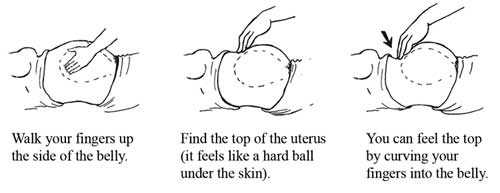
Effigy 10.one With the woman lying on her back, begin by finding the acme of the uterus with your fingers. Then meet how many months significant the woman is by comparing the number of fingers with Figure x.2 (each line is well-nigh the width of ii fingers).
10.ii.1 How to measure out fundal superlative using the finger method
If the top of the uterus is below the bellybutton, measure how many fingers below the bellybutton it is. If the top of the uterus is to a higher place the bellybutton, measure how many fingers above the bellybutton it is.
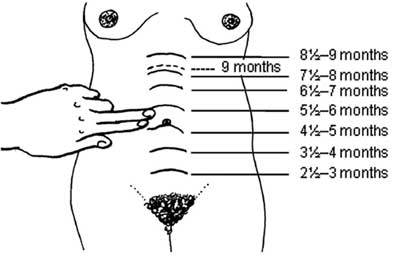
Figure ten.2 Measuring fundal tiptop using the finger method. The woman is lying on her back. Each line represents the width of two fingers.
-
Look advisedly at Figure x.two. If the baby is growing usually, by how many finger-widths should the uterus rising in the second trimester (3-6 months of pregnancy, or 15-27 completed weeks of gestation)?
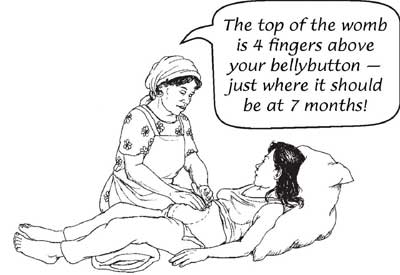
Figure 10.3 Fundal height at 7 months' gestation.
-
Fundal height should increase by 6 finger-widths (two finger-widths every month) in the 2d trimester.
-
How many fingers above the bellybutton should the meridian of the uterus exist at 7 months' gestation?
-
See Figure 10.3 for the answer.
-
How do you explain the position of the dotted line at ix months in Figure x.2, which is below the line showing fundal pinnacle at 8½ to nine months?
-
Babies may drib lower in the weeks just before birth (look back at Box 10.1).
-
Look at the diagrams in Figure 10.iv (a) and (b). How many weeks pregnant is the adult female in each case, based on the finger method of measuring fundal acme shown in Effigy 10.2?
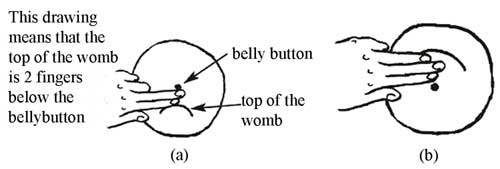
Figure 10.4 (a) and (b) How many months of pregnancy exercise you think each of these diagrams shows?
-
In Figure 10.4(a) the adult female is nearly 4½ months significant. In Figure 10.4 (b) she is virtually 6½ months significant (iii fingers above the bellybutton).
When you measure fundal height at every antenatal visit, write downward the number of fingers you lot used to measure the height of the uterus on the woman'south antenatal record card. Put a '+' (plus) sign in front of the number if the pinnacle of the uterus is above the bellybutton. Put a '–' (minus) sign in front of the number if the tiptop of the uterus is below the belly button.
-
How would you lot record the measurements shown in Figure 10.iv(a) and (b)?
-
The measurement in Figure x.four(a) would be recorded as -2. The measurement in Figure 10.iv(b) would be +iii.
Limitations of the finger method
Yous need to be aware that the finger method for estimating gestational age (the number of weeks/months of pregnancy) has some limitations that affect its accuracy.
-
Look at your ain hands. Can you suggest why the finger method might requite a different guess of gestational age if ii different wellness workers used this method to measure the aforementioned woman's fundal top?
-
Considering of the big variation in the thickness of our fingers, there could be up to three weeks departure between the fundal height measurement of the same adult female fabricated by ii different people. (This is known equally 'inter-observer variation', i.eastward. variation between unlike observers.)
Even if the same health worker measures the fundal height of the same woman several times on the same day, the answer may be different each time, because the finger method is not very precise. (This is known equally 'intra-observer variation', i.east. variation past a single observer at different times.)
Finally, you might accept realised that the distance betwixt the symphysis pubis (pubic bone) and the umbilicus (bellybutton) varies between women when they are not significant, and this variation affects the accuracy of the fundal height measurement using the finger method. For case, it assumes that the altitude between the pubic symphysis and the belly button is xx cm at 20 weeks' gestation, merely information technology can be as long as thirty cm and as short every bit xiv cm.
To overcome these limitations, it is recommended that you measure fundal height using a soft tape measure if you take one, as described side by side.
10.two.two How to measure fundal summit using a soft tape measure out
You lot can utilise this method when the elevation of the uterus grows as high equally the adult female'southward belly button.
During the second half of pregnancy, the size of the uterus in centimetres is close to the number of weeks that the woman has been pregnant. For example, if it has been 24 weeks since her last normal menstrual period, the uterus will ordinarily measure 22-26 cm. The uterus should abound about i cm every week, or iv cm every calendar month.
- Lay a cloth or soft plastic measuring record on the mother'southward abdomen, holding the 0 (zero) on the tape at the top of the pubic bone (encounter the pointer in Effigy 10.5a).
- Follow the curve of her abdomen, and hold the tape at the top of her uterus (Figure 10.5b).
- Write down the number of centimetres (cm) from the superlative of the pubic bone to the top of the uterus.

Effigy 10.5 (a) The arrow points to the meridian of the pubic os. Place the 0 (zero) of the record measure hither. (b) Follow the curve of the woman's abdomen and hold the tape at the elevation of her uterus.
Doctors, nurses and many midwives are taught to count pregnancy by weeks instead of months. They start counting at the beginning day of the concluding normal menstrual menstruum (LNMP), even though the woman probably got pregnant ii weeks later. Counting this fashion makes near pregnancies 40 weeks long (or you can say a normal gestation is forty weeks).
10.iii What if the size of the uterus is not what you expected?
If you are measuring correctly and you lot do not find the meridian of the uterus where you await it to be, based on the engagement the woman gave you for her LNMP, it could mean three dissimilar things:
- The due date y'all got past counting from the LNMP could be wrong.
- The uterus (and the baby) could be growing too fast.
- The uterus (and the baby) could be growing too slowly.
10.3.1 The due appointment you got past counting from the LNMP is wrong
There are several reasons why a due date figured from the LNMP could be incorrect. Sometimes women do non retrieve the engagement of their LNMP correctly. Sometimes a woman misses her menstruation for another reason, and so gets pregnant afterwards. This woman could really be less pregnant than yous thought, so the uterus is smaller than you look. Or sometimes a adult female has a piddling haemorrhage after she gets pregnant. If she assumed that was her LNMP, this woman volition be i or two months more pregnant than y'all thought. The uterus will exist bigger than y'all expect.
Retrieve due dates are not verbal. Women often give nascence up to 2 or 3 weeks earlier or afterwards their due engagement. This is unremarkably safe.
If the due engagement does non match the size of the uterus at the beginning visit, brand a note. Wait and measure the uterus again in ii to four weeks. If the uterus grows about two finger-widths or ane cm a month, the due date that you got from feeling the top of the uterus is probably right. The due date y'all got by counting from the LNMP was probably incorrect.
10.iii.2 The uterus is growing too apace
If the uterus grows more than 2 finger-widths a month, or more 1 cm a week, several different causes are possible:
- The mother may accept twins.
- The mother may have diabetes.
- The female parent may have besides much water (amniotic fluid) in the uterus.
- The mother may have a molar pregnancy (a tumour instead of a infant).
 If yous recollect there might be twins, even if you can find but one heartbeat, refer the woman to the nearest health eye.
The mother may have twins
It can exist very difficult to know for certain that a female parent is pregnant with twins. Signs of twins are that:
- The uterus grows faster or larger than normal.
- Y'all can feel ii heads or two bottoms when you feel the mother'due south belly.
- You tin hear two heartbeats. This is not like shooting fish in a barrel to discover, simply it may be possible in the terminal few months.
We will show yous how to listen to the fetal heartbeat through the mother's abdomen in Report Session 11. For now, we are focusing on twins equally a possible reason for the uterus beingness larger than expected. Here are two ways to attempt to hear the heartbeats of twins:

Effigy 10.6 Tapping the rhythm of the fetal heartbeats may tell y'all if there is one baby or two.
- Find the heartbeat of one infant. Ask a helper to listen for other places where the heartbeat is easy to hear. If she hears a heartbeat, ask her to listen to one place while you heed to the other. Each of you can tap the rhythm of the heartbeat with your hand. If the rhythms are the aforementioned, you may exist listening to the same infant. If the rhythms are not exactly the same, y'all may be hearing two dissimilar babies (Figure 10.half dozen).
- If y'all practice not accept a helper, but you have a watch with a second hand, or a homemade timer, endeavour timing each heartbeat separately. If the heartbeats are non the same, yous may exist hearing two dissimilar babies.
Considering twin births are often more than difficult or dangerous than single births, it is safer for the adult female to go to a hospital to give birth. Since twins are more than probable to be born early on, the mother should attempt to have transportation ready at all times after the 6th month. If the hospital is far away, the mother may wish to movement closer in the last months of pregnancy. Be certain to have a plan for how to become help in an emergency.
The mother may have diabetes
You learned nearly the warning signs of diabetes in Written report Session 9.
-
If a woman had all the warning signs of diabetes, what would you lot await to notice?
-
 Refer the woman to a health middle if you suspect she may accept diabetes.
She had diabetes in a by pregnancy. One of her past babies was born very large (more iv kilograms), or was sick or died at birth and no one knows why. She is fat. She is thirsty all the fourth dimension. She has frequent itching and a bad olfactory property coming from her vagina. Her wounds heal slowly. She has to urinate more often than other pregnant women. Her uterus is bigger than normal for how many months she has been pregnant. She has sugar in her urine when you lot do the dipstick examination (Section 9.8.ane of Study Session 9).
Too much water in the uterus
Too much water (amniotic fluid) is not always a trouble, but it tin cause the uterus to stretch too much. Then the uterus cannot contract enough to button the baby out, or to terminate the bleeding after the birth. In rare cases, it tin mean that the baby volition have nascency defects. Endeavour to refer the adult female to the nearest health facility that can give her a sonogram (ultrasound exam) if the uterus is measuring also big and y'all do not suspect twins.
Molar pregnancy (tumour)
Sometimes a adult female gets pregnant, merely a tumour grows instead of a baby. This is called a molar pregnancy (Figure ten.7). Blood spotting and tissue (sometimes shaped like grapes) may be discharged from her vagina.
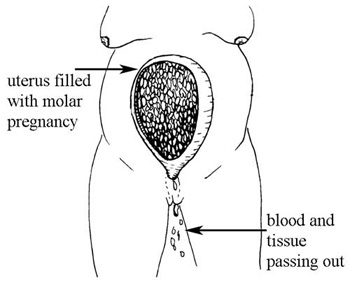
Figure x.7 A molar pregnancy (tumour) growing in the uterus instead of a baby.
If you lot detect the signs and symptoms of a tooth pregnancy, refer the woman to a hospital as soon as possible. The tumour can become a cancer and impale her, sometimes very rapidly. A surgeon tin can remove the tumour to save the woman's life.
Other signs of a molar pregnancy are that:
- No fetal heartbeat can exist heard.
- No infant can be felt.
- The woman has had nausea all through the pregnancy.
- She has spotting of blood, and tissue shaped like bunches of grapes coming from her vagina.
10.3.three The uterus is growing also slowly
Slow growth can exist a sign of one of these issues:
- The female parent may accept too little water (amniotic fluid) in the uterus. Sometimes there is less water than usual, and everything is still OK. At other times, as well little water can mean the baby is not normal, or will take bug during the labour.
- The mother may take a poor nutrition. Observe out what kind of food the mother has been eating. If she is besides poor to get enough good food, try to find some way to help her and her baby. Healthy mothers and children make the whole community stronger.
- The female parent may have high blood pressure level (hypertension). Loftier blood pressure can go on the baby from getting the nutrition it needs to grow well. You lot learned how to check her blood pressure in the previous study session.
- The mother may be drinking alcohol, smoking, or using drugs. These can cause a baby to exist small. Endeavour to find some way to help her to stop these damaging behaviours.
- The babe may be dead. Expressionless babies do non grow, so the uterus stops getting bigger.
If you do not accept the right equipment to check her claret force per unit area, and the uterus is growing too slowly, refer her to the nearest health centre for evaluation.
How to tell if the infant is dead
If you doubtable that the baby may have died, refer the female parent to a health middle for the stillbirth.
If the mother is five months pregnant or more, inquire if she has felt the baby move recently. If the baby has not moved for two days, something may be wrong. If the mother is more seven months significant, or if you heard the infant'due south heartbeat at an earlier visit, listen for the heartbeat once more.
If the woman reports no fetal movements and you cannot hear the heartbeat, the baby may have died. If then, it is important for a dead baby (stillbirth) to be delivered soon, considering the woman may drain more than than other mothers, and she is at more risk of infection.
When a mother loses a baby, she needs love, care and agreement (Effigy 10.8). Make sure that she does not become through labour alone. If she gives birth to a dead baby in the hospital, someone she trusts should stay at that place with her during the birth.

Figure 10.eight When a mother loses a baby, she needs dear, care and agreement.
x.4 Conclusion
In this written report session, you have learned how to measure the fundal height, using your fingers and a measuring tape. Y'all take also learned to interpret of your measurements and have the appropriate deportment. In the side by side study session you will acquire how to assess the position of the baby by palpating (feeling) the mother's abdomen and listening to the position of the fetal heartbeat.
Summary of Study Session ten
In Study Session 10, you take learned that:
- Measuring the fundal height tells you the duration of the pregnancy, how fast the babe is growing, and the probable due appointment.
- Remember to position the woman correctly before measuring the fundal height. The fundus of the uterus grows on average two finger-widths for each month of pregnancy.
- If the fundal height is not equal to the gestational age, you demand to check the duration of pregnancy from the last normal menstrual period (LNMP). Having the wrong date is 1 of the master reasons for discrepancy between fundal top and gestational historic period.
- If the fundal height is bigger than expected for gestational age, the mother may accept given you the wrong LNMP, or she may take twins, diabetes, too much water in the uterus, or a tooth pregnancy.
- If the fundal height is smaller than expected for gestational historic period, the mother may have given yous the wrong LNMP, she may accept too little amniotic fluid surrounding the fetus, raised blood pressure, poor diet, she may be drinking alcohol or taking other harmful drugs, or the baby may exist dead.
Self-Assessment Questions (SAQs) for Report Session x
Now that you have completed this study session, you lot can assess how well you have achieved its Learning Outcomes by answering the questions below Case Study ten.1. Write your answers in your Study Diary and hash out them with your Tutor at the next Report Support Meeting. You can check your answers with the Notes on the Self-Assessment Questions at the end of this Module.
Instance Written report x.1 Abebech
Abebech is a meaning woman, whose duration of gestation based on her terminal normal menstrual menstruation (LNMP) is vi months. When you examine her, you can experience that the fundus is four finger-widths in a higher place her omphalus and you tin hear a fetal heartbeat clearly.
SAQ 10.1 (tests Learning Outcomes 10.1 and x.2)
- a.What is your assessment of the gestational age of Abebech's baby using fundal height measurement?
- b.How many centimetres would Abebech's belly measure from her pubic bone to the superlative of her uterus in order to ostend your fundal superlative measurement?
Answer
- a.The gestational age based on the fundal summit measurement is seven months.
- b.If Abebech is really seven months pregnant, you would expect her belly to measure out about 28 cm from her pubic os to the tiptop of the uterus, i.e. approximately one centimetre for each week of pregnancy dated from the LNMP. Remember the measurement may range from 26-30 cm.
SAQ 10.2 (tests Learning Upshot 10.3)
Is the gestational age of Abebech's baby based on fundal height measurement consequent with the gestational age calculated from her LNMP?
Reply
The gestational age based on fundal height is one month more than expected from the appointment of the LNMP. Therefore, the uterus is bigger than expected from the appointment of the LNMP.
SAQ x.3 (tests Learning Effect 10.4)
What possible explanations tin can yous requite for your findings in Abebech's instance, and what deportment should you take?
Answer
The uterus may be bigger than expected because the engagement of the LNMP may exist incorrect, and Abebech is really 7 months meaning. This is not a problem, just it is of import to investigate other possible explanations. For example, she may have likewise much amniotic fluid (water) surrounding the infant in the uterus; you should refer her to a health facility where she can have an ultrasound examination to discover out if this is the problem. Or she could have a twin pregnancy. Y'all can hear one fetal heartbeat conspicuously, so go someone else to help y'all listen to Abebech's abdomen to see if y'all can hear ii fetal heartbeats. If you doubtable she is having twins, refer her to the nearest wellness facility.
lindsleyworessold.blogspot.com
Source: https://www.open.edu/openlearncreate/mod/oucontent/view.php?id=40&printable=1

Post a Comment for "Can You See the Sex of a Baby at 14 Weeks With a Sonagram?"